
Peptides
KLOW blend (BPC-157 / TB-500 / KPV / GHK-Cu), in plain English
Four peptides in one vial, each doing a different job on the repair crew — what the research supports, what it doesn't, and how a provider decides.
7 min read
The repair-crew analogy
Think of an injured area as a construction site. Healing needs four different trades to show up: someone to run new supply lines, someone to move workers into place, someone to keep the noise and chaos down, and someone to lay new material.
KLOW is a compounded blend of four peptides — BPC-157, TB-500, KPV, and GHK-Cu — each of which has been studied for a different part of that job. The idea behind combining them is coverage of the whole repair sequence rather than one slice of it.
That is the rationale, not a proven outcome. Blends are not separately studied the way single molecules are, so the evidence below is component-by-component.
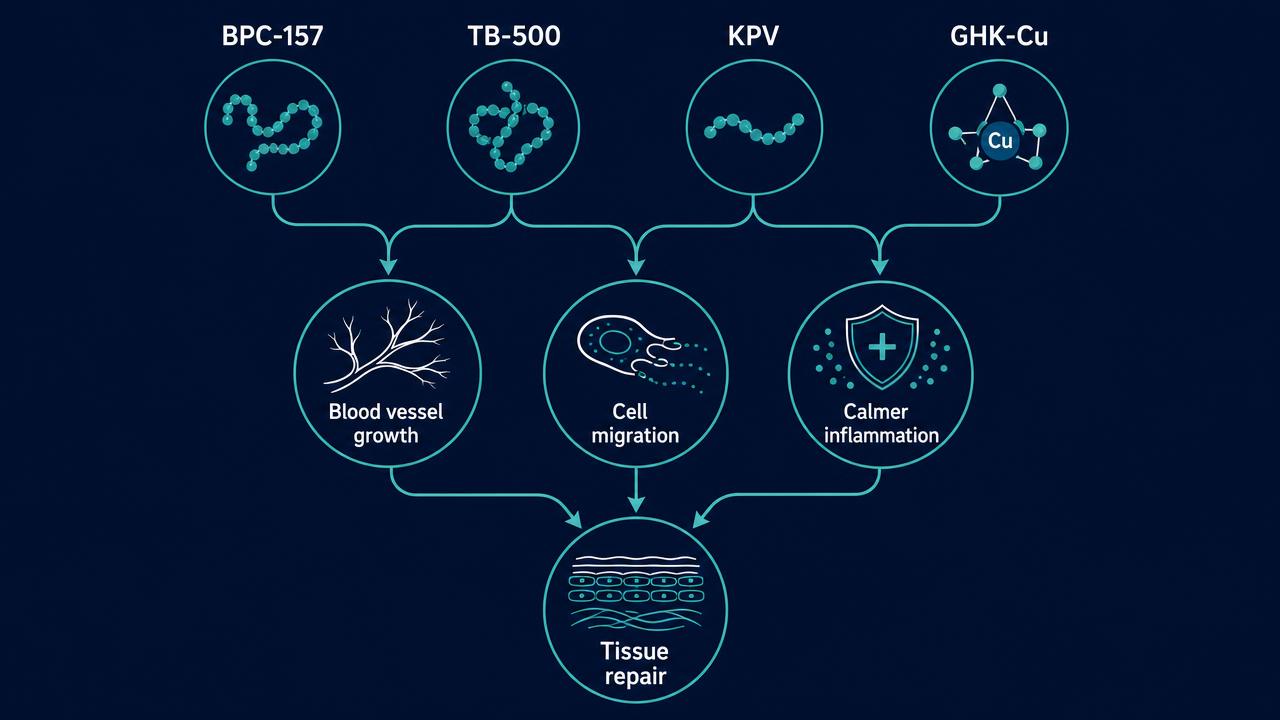
BPC-157 — the supply lines
A 15-amino-acid peptide derived from a sequence found in gastric juice. Preclinical work focuses on angiogenesis — the growth of new blood vessels into damaged tissue — plus growth-factor and nitric-oxide signalling.
In the analogy, BPC-157 is the crew that runs water and power to the site. Without circulation, nothing else heals efficiently.
Evidence: extensive animal and cell-culture data on tendon, ligament, muscle, and gut lining; limited controlled human trials.
TB-500 — moving workers into place
TB-500 is a synthetic fragment of thymosin beta-4, a naturally occurring protein involved in actin regulation. Actin is the internal scaffolding cells use to change shape and crawl.
Practically, that means cell migration: getting repair cells to the damaged spot. Preclinical studies have looked at wound closure, cardiac tissue, and connective-tissue models.
Evidence: mostly animal and in-vitro; thymosin beta-4 itself has been through some early human trials in wound and eye indications.
KPV — turning down the noise
KPV is a three-amino-acid fragment (lysine-proline-valine) of alpha-MSH, a hormone with well-described anti-inflammatory activity. The fragment appears to retain the anti-inflammatory signalling without the pigmentation effects of the full hormone.
Inflammation is necessary early in healing and counterproductive when it lingers. KPV is the component studied for keeping that response proportionate — gut-inflammation models are the most common setting in the literature.
Evidence: preclinical, with the strongest signal in colitis and skin-inflammation models.
GHK-Cu — laying new material
GHK-Cu is a copper-binding tripeptide found naturally in human plasma, with levels that decline substantially with age. It is the most studied of the four in humans, largely through dermatology.
Research describes stimulation of collagen and elastin production, antioxidant activity, and regulation of genes involved in remodelling. Topical GHK-Cu has real human data in skin studies; injectable use is a different route with a thinner evidence base.
In the analogy, GHK-Cu is the crew laying new structural material once the site is prepped.
Why combine them
Each peptide targets a different stage — circulation, cell migration, inflammation control, matrix rebuilding. A blend gives one injection instead of four and, in theory, covers the sequence rather than a single step.
The honest caveat: combination products are rarely studied as combinations. There is no large human trial of KLOW as a blend. What exists is component-level preclinical research plus clinical experience.
Realistic timelines and side effects
Protocols are typically run in cycles of several weeks rather than indefinitely, with a provider reassessing before continuing. Soft-tissue remodelling is measured in weeks to months, not days.
The most commonly reported effects are injection-site reactions — redness, itching, a temporary lump — along with occasional flushing or fatigue. GHK-Cu can sting more than the others on injection.
Anyone promising a guaranteed timeline is overselling. Individual response varies with the injury, age, sleep, nutrition, and training load.
How a provider evaluates candidacy
A US-licensed clinician reviews your history, medications, and goals before prescribing. Active or recent malignancy is a standard reason to decline, since several of these pathways involve growth and angiogenesis signalling. Pregnancy, breastfeeding, and certain autoimmune or copper-metabolism conditions (such as Wilson's disease, relevant to GHK-Cu) are also screening points.
Competitive athletes should know that several peptides in this class appear on anti-doping prohibited lists. Check with your governing body before starting.
If a protocol is appropriate, dose, frequency, and duration are individualized and reviewed at follow-up rather than set once and forgotten.
The bottom line
KLOW combines four peptides with distinct, mechanistically plausible roles in tissue repair. The preclinical base is genuine and the human evidence is early — strongest for GHK-Cu, thinnest for the blend as a whole.
Treat it as a physician-supervised adjunct to good rehab, sleep, and nutrition, not a replacement for them. Decisions belong with a prescriber who knows your history.
Compounded medications are not FDA-approved and are prepared by licensed US pharmacies for an individual patient with a valid prescription. Individual results vary. Nothing here is medical advice.
Ready to talk to a provider?
Complete a short intake and a licensed clinician will tell you whether a protocol fits your history and goals.
Keep reading
Peptides
BPC-157: What the research actually says
Weight Management
GLP-1 vs. dual and triple agonists: what's the difference?
Getting Started
How telehealth prescribing works at EpixNXT
Getting Started
Why telehealth? The case for online peptide care
Longevity
NAD+ and cellular energy: why it matters
Peptides
Tesamorelin: your body's own growth-hormone signal, explained
Peptides
Why stack peptides? How combinations unlock benefits
Peptides
Kisspeptin in plain English: the master switch of reproductive signaling
Peptides
Selank: from Russia with calm